In control engineering, every system falls into one of two categories — Open Loop or Closed Loop. Understanding the difference between them is fundamental to automation, PLC programming, and industrial control. In this article, we'll explain both systems with real-life examples, block diagrams, and a clear comparison table.
Table of Contents
What is a Control System?
A control system is an arrangement of components that manages, commands, or regulates the behavior of another system to achieve a desired output. Every control system has three basic elements:
- Input — the desired value (setpoint)
- Controller/Process — the system that acts on the input
- Output — the actual result
The key question is: does the system check its own output and correct itself? If yes → closed loop. If no → open loop.
Open Loop Control System
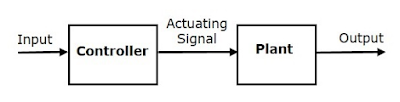
An open loop control system is one where the output has NO effect on the control action. The system does not monitor or correct its output — it simply executes the command blindly.
It is also called a Non-Feedback System because there is no feedback path from output to input.
Block Diagram
Examples of Open Loop Systems
- Immersion Rod (Water Heater) — It heats water continuously regardless of temperature. It doesn't know when to stop — you have to manually switch it off.
- Traffic Light — The timing for red, yellow, and green is fixed. It doesn't adjust based on actual traffic density.
- Washing Machine (Timer-based) — Runs for a preset time regardless of how clean the clothes are.
- Toaster — Heats bread for a fixed duration. Doesn't check if the toast is done.
Advantages
- Simple design and easy to construct
- Economical — fewer components needed
- Low maintenance
- Stable — no risk of oscillation (no feedback loop)
Disadvantages
- Inaccurate — cannot correct errors or disturbances
- Unreliable for precision applications
- Cannot handle changes in load or environment
- Requires manual intervention for correction
Closed Loop Control System
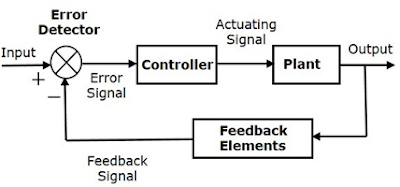
A closed loop control system is one where the output is continuously measured and fed back to the input for comparison. If there's a difference (error) between desired and actual output, the controller corrects it automatically.
It is also called a Feedback System because the output signal is fed back to the input through a feedback element. The concept of feedback is also used in transfer function derivation of closed loop systems.
Block Diagram
Examples of Closed Loop Systems
- Air Conditioner — The thermostat measures room temperature and compares it with the set temperature. If the room is too warm, the compressor turns ON. Once the desired temperature is reached, it turns OFF.
- Cruise Control in Cars — Maintains set speed by automatically adjusting throttle based on actual speed feedback.
- Automatic Iron — Thermostat senses fabric temperature and switches heating element ON/OFF to maintain set temperature.
- Human Body Temperature — Brain detects temperature change → triggers sweating (cooling) or shivering (heating) to maintain 37°C.
Advantages
- Highly accurate — continuously corrects errors
- Reliable — adapts to disturbances and load changes
- Faster response to changes
- Can handle multiple variables simultaneously
Disadvantages
- More expensive — requires sensors, feedback elements, comparators
- Complex design and installation
- Higher maintenance
- Risk of instability/oscillation if poorly designed
Open Loop vs Closed Loop — Comparison
Real-World Applications
Where Open Loop is Used
- Simple appliances (toaster, washing machine timer)
- Traffic signal control (fixed timing)
- Stepper motor positioning (pre-calculated steps)
- Conveyor belt running at fixed speed
Where Closed Loop is Used
- Industrial automation — PLC-controlled processes use closed loop extensively
- Temperature control (furnaces, ovens, HVAC)
- Speed control (DC motor speed control, VFD-driven motors)
- Robotics and CNC machines
- Power system voltage regulation
Frequently Asked Questions
Q1: What is the main difference between open loop and closed loop?
The main difference is feedback. Open loop has no feedback — output doesn't affect control. Closed loop has feedback — output is measured and compared with input to correct errors.
Q2: Which system is more accurate?
Closed loop is more accurate because it continuously monitors output and corrects any deviation from the desired value.
Q3: Can an open loop system become closed loop?
Yes — by adding a sensor to measure output and a feedback path to compare it with the input. For example, adding a thermostat to a simple heater converts it from open loop to closed loop.
Q4: Why are closed loop systems sometimes unstable?
If the feedback gain is too high or there are delays in the system, the controller can overcorrect, causing oscillations. Proper tuning (e.g., PID tuning) prevents this.
Q5: Is a PLC-based system open loop or closed loop?
It depends on the application. A PLC can implement both. If it reads sensors and adjusts outputs based on feedback, it's closed loop. If it runs a fixed sequence without feedback, it's open loop.
Conclusion
Open loop and closed loop are the two fundamental architectures of every control system. Open loop is simple and cheap but inaccurate. Closed loop is complex and expensive but highly accurate and self-correcting. Most industrial automation systems (PLCs, SCADA, VFDs) use closed loop control because precision and reliability are non-negotiable in production environments.
Remember: If the system checks its own output and corrects itself → Closed Loop. If it doesn't → Open Loop.